
Are you missing out on top-notch clinical talent because of delay in onboarding?
Well, healthcare organizations around the globe are currently experiencing staffing shortages and an increase in patient demand. All these resulting in a growing pressure to fill critical roles quickly. As a result, many hospitals are compromising on the quality of talent.
Yet despite the urgency, many healthcare hiring processes encounter a significant bottleneck before a candidate can begin work: credentialing.
While recruiters may identify qualified physicians, nurses, allied health professionals, and contingent workers within days, the credentialing process can often extend hiring timelines by weeks or even months. The result is delayed onboarding, increased labor costs, and prolonged workforce gaps.
Understanding why credentialing delays occur is the first step toward building a faster and more efficient healthcare hiring process.
In this post, we will discuss the healthcare credentialing process and uncover ways to solve hiring bottlenecks and improve quality of talent hired, reduce time-to-fill critical clinical roles, and more.
Let’s get started by understanding the healthcare credentialing process.
What Is Healthcare Credentialing?
Credentialing is the process of verifying a healthcare professional’s qualifications before they can provide patient care.
This typically includes:
- Education verification
- Professional license validation
- Board certifications
- Employment history checks
- Background screenings
- Sanctions and exclusion list monitoring
- Malpractice insurance verification
- Clinical competency assessments
Why Credentialing Delays Healthcare Hiring?
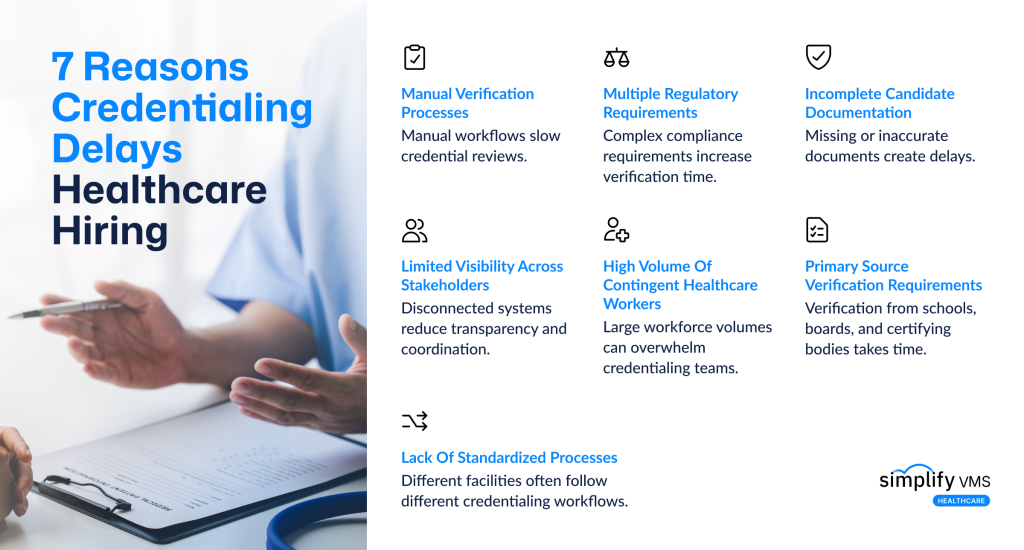
Manual Verification Processes
Many healthcare organizations still rely on emails, phone calls, spreadsheets, and paper-based workflows to verify credentials.
Recruiters and credentialing teams may need to contact multiple institutions, licensing boards, and previous employers individually. Every manual step adds time and increases the risk of errors or missing information.
Without automation, even a straightforward credential review can become a lengthy administrative process.
Multiple Regulatory Requirements
Healthcare is one of the most heavily regulated industries in the world.
Organizations must comply with:
- Federal regulations
- State licensing requirements
- Accreditation standards
- Hospital-specific policies
- Insurance provider requirements
A candidate who meets requirements in one state or facility may require additional verification elsewhere, creating extra work and longer approval cycles.
Incomplete Candidate Documentation
Credentialing frequently stalls because required documents are missing, expired, or submitted incorrectly.
Common issues include:
- Expired licenses
- Missing certifications
- Incomplete employment records
- Incorrect application details
- Delayed responses from candidates
Even highly qualified candidates can face onboarding delays when documentation gaps are discovered late in the hiring process.
Limited Visibility Across Stakeholders
Credentialing often involves multiple stakeholders:
- Recruiters
- Credentialing specialists
- Hiring managers
- Compliance teams
- MSP partners
- Staffing agencies
When information is stored across different systems, stakeholders lack visibility into progress and outstanding requirements.
This fragmentation creates communication delays, duplicate work, and uncertainty around hiring timelines.
High Volume of Contingent Healthcare Workers
The growing use of travel nurses, locum tenens, physicians, and contingent healthcare professionals has added another layer of complexity.
Healthcare organizations may need to credential hundreds or thousands of temporary workers across multiple facilities simultaneously.
Managing these volumes manually can overwhelm credentialing teams and create significant backlogs.
Primary Source Verification Requirements
Many healthcare credentials require primary source verification, meaning information must be confirmed directly with the issuing organization.
Examples include:
- Medical schools
- Nursing schools
- Licensing boards
- Certification authorities
Responses from these organizations can vary significantly in speed, making timelines difficult to predict and control.
Lack of standardized processes
Different facilities often maintain different credentialing standards and approval workflows.
As a result:
- Requirements vary by location
- Documentation standards differ
- Approval paths become inconsistent
This lack of standardization slows hiring and creates confusion for candidates and recruiters alike.
The Business Impact of Credentialing Delays
Credentialing delays affect more than just hiring teams.
Increased Vacancy Costs
Every unfilled position can lead to:
- Overtime expenses
- Burnout among existing staff
- Reduced workforce flexibility
- Higher agency spending
Slower Patient Care Delivery
Critical staffing shortages can impact:
- Patient access
- Appointment availability
- Service expansion efforts
- Overall patient experience
Candidate Drop-Off
Top healthcare professionals often receive multiple job offers.
If credentialing takes too long, candidates may accept positions elsewhere before onboarding is completed.
Reduced Operational Efficiency
Recruiters spend valuable time tracking documents, following up on approvals, and managing administrative tasks rather than focusing on talent acquisition.
How Technology Can Accelerate Credentialing?
Modern healthcare workforce platforms help organizations streamline credentialing through automation and centralized workflows.
Key capabilities include:
Automated Credential Tracking
Systems can automatically monitor:
- License expirations
- Certification renewals
- Compliance requirements
- Missing documentation
This reduces manual oversight and prevents last-minute surprises.
Centralized Workforce Records
A single source of truth allows recruiters, compliance teams, and hiring managers to access the same information in real time.
Workflow Automation
Automated workflows can:
- Route approvals
- Trigger notifications
- Escalate overdue tasks
- Track credentialing progress
This helps eliminate bottlenecks and improve accountability.
Real-Time Compliance Visibility
Healthcare organizations gain immediate visibility into workforce readiness and compliance status across facilities and worker populations.
Modern Healthcare Vendor Management solutions help organizations streamline credentialing and compliance across multiple staffing suppliers. By centralizing workforce data, automating credential tracking, and improving visibility across stakeholders, organizations can reduce onboarding delays and maintain compliance more efficiently.
Credentialing will always remain an essential component of healthcare hiring. However, delays are not inevitable.
Organizations that modernize credentialing workflows, standardize processes, improve visibility, and leverage automation can significantly reduce onboarding timelines while maintaining compliance and patient safety.
As healthcare workforce shortages continue to challenge providers worldwide, accelerating credentialing may become one of the most impactful ways to improve hiring speed, workforce readiness, and operational performance.
Final Thoughts
Healthcare organizations cannot afford lengthy hiring delays when patient care depends on having the right professionals in place at the right time.
While credentialing remains a critical safeguard, outdated manual processes often create unnecessary bottlenecks. By embracing automation, centralized workforce management, and real-time compliance tracking, healthcare providers can transform credentialing from a hiring obstacle into a strategic advantage.
The organizations that streamline credentialing today will be better positioned to attract talent, reduce staffing shortages, and deliver exceptional patient care tomorrow.
We hope this article provided valuable insights into reducing credentialing delays and improving healthcare hiring efficiency.
For more insights on healthcare staffing, compliance, and workforce management, explore these related articles:
How AI Helps Healthcare Organizations Overcome Staffing Gaps
Agentic AI: Next-Generation Staffing Automation and Workforce Management
How Better Shift Management Supports a Stronger Healthcare Workforce
FAQs
What is the credentialing process in healthcare?
Healthcare credentialing is the process of verifying a clinician’s qualifications, including education, licenses, certifications, work history, training, and professional references. Healthcare organizations use credentialing to ensure providers meet regulatory, payer, and patient safety requirements before delivering care. This process helps reduce risk, maintain compliance, and protect the quality of patient outcomes.
How long does credentialing take at a hospital?
Hospital credentialing typically takes between 60 and 180 days, depending on the provider type, specialty, licensing requirements, and the efficiency of the verification process. Delays can occur due to incomplete documentation, slow responses from primary sources, payer enrollment requirements, or manual administrative processes. Organizations that use automated credentialing tools often reduce turnaround times significantly.
How can healthcare organizations reduce credentialing delays?
Healthcare organizations can reduce credentialing delays by automating document collection, centralizing provider data, implementing digital workflows, and tracking credential expiration dates proactively. Standardized processes, real-time status visibility, and integration with licensing and verification databases also help accelerate approvals while minimizing administrative burden and compliance risks.
How can healthcare organizations improve hiring while maintaining compliance?
Organizations can improve hiring by streamlining credential verification, automating onboarding workflows, and conducting compliance checks earlier in the recruitment process. Leveraging workforce technology enables recruiters to identify qualified candidates faster while ensuring all licensing, certification, background screening, and regulatory requirements are met before providers begin work.
How can Healthcare Vendor Management solutions support credentialing and compliance?
Healthcare Vendor Management Solutions (VMS) help automate credential tracking, document collection, compliance validation, and supplier oversight. They provide centralized visibility into workforce credentials, generate alerts for upcoming expirations, standardize onboarding processes, and maintain audit-ready records. This enables healthcare organizations to hire contingent staff faster while reducing compliance risks and administrative effort.